A SOC analyst closes a ticket on a lookalike domain spoofing the company's login page. Across the building, a trust and safety reviewer flags a fake executive account that just started gaining followers. Neither one knows that a third event, a batch of employee credentials showing up for sale on a dark web forum, traces back to the same attacker. Each alert gets handled on its own, resolved, and filed away, with nothing in the record to say these three things belong together.
That gap is the real problem behind brand impersonation today. The threats themselves are not especially rare or exotic. What is missing is the connective layer that takes a phishing domain, a fake profile, and a leaked credential set and recognizes them as pieces of one attack campaign rather than three unrelated incidents. Bolster's approach is built around closing that gap: detect the individual threat, investigate what it is, connect it to related activity, and act on the full campaign rather than the single asset in front of you.
The fragmented view security teams start with
Brand impersonation does not happen inside the network perimeter most security tools are built to watch. A lookalike domain gets registered on infrastructure the company never touches. A fake social profile goes up on a platform the company doesn't control. A fraudulent app lands in a store the company didn't build. None of it crosses a firewall, so none of it trips the alarms that firewalls, endpoint tools, or traditional network monitoring are designed to raise.
That leaves detection to whatever is actually watching the open web, social platforms, app stores, marketplaces, and the dark web for abuse of the brand. When that monitoring works, it generates a steady stream of individual findings: a domain here, a profile there, a listing somewhere else. Each one arrives as its own ticket, investigated and closed on its own terms.
The practical effect is that a security team can be doing everything right at the detection layer and still miss the pattern sitting right in front of them. Three separate findings, each handled correctly, can still hide a single coordinated actor running all three.
Why alert volume hides the real threat
More alerts are not the same as more insight. A team that detects everything but connects nothing ends up with a long queue and very little clarity about which items in that queue actually matter. Group-IB's research on digital brand protection describes the tradeoff plainly: without an analysis layer sitting on top of raw detections, teams either miss real threats buried in the noise or get overwhelmed trying to triage false positives one at a time.
This is where the value of correlation becomes concrete rather than abstract. A platform that only counts how many channels it watches is answering the wrong question. The useful question is whether the detections coming out of those channels get tied together, so a security lead reviewing the alert queue sees one campaign with five linked assets instead of five disconnected tickets competing for the same attention.
Raw volume, on its own, makes the job harder rather than easier. A team drowning in unlinked alerts spends its time deciding what to look at next, not acting on what it has already found.
Where brand threats surface before they are connected
Before any linkage happens, every one of these threats shows up somewhere specific, and the specifics matter because they determine what a monitoring program actually has to watch.
Phishing and typosquatting domains are the most familiar entry point: a near-miss spelling of the brand, registered recently, built to catch anyone who mistypes a URL or clicks a link in a scam email. Fake social profiles follow a similar pattern on a different surface, often built around an executive's name and photo rather than the company's. Group-IB has documented fake executive accounts attracting millions of views within days of going live, which gives an attacker a direct channel to employees, customers, or partners before anyone flags the account as fraudulent.
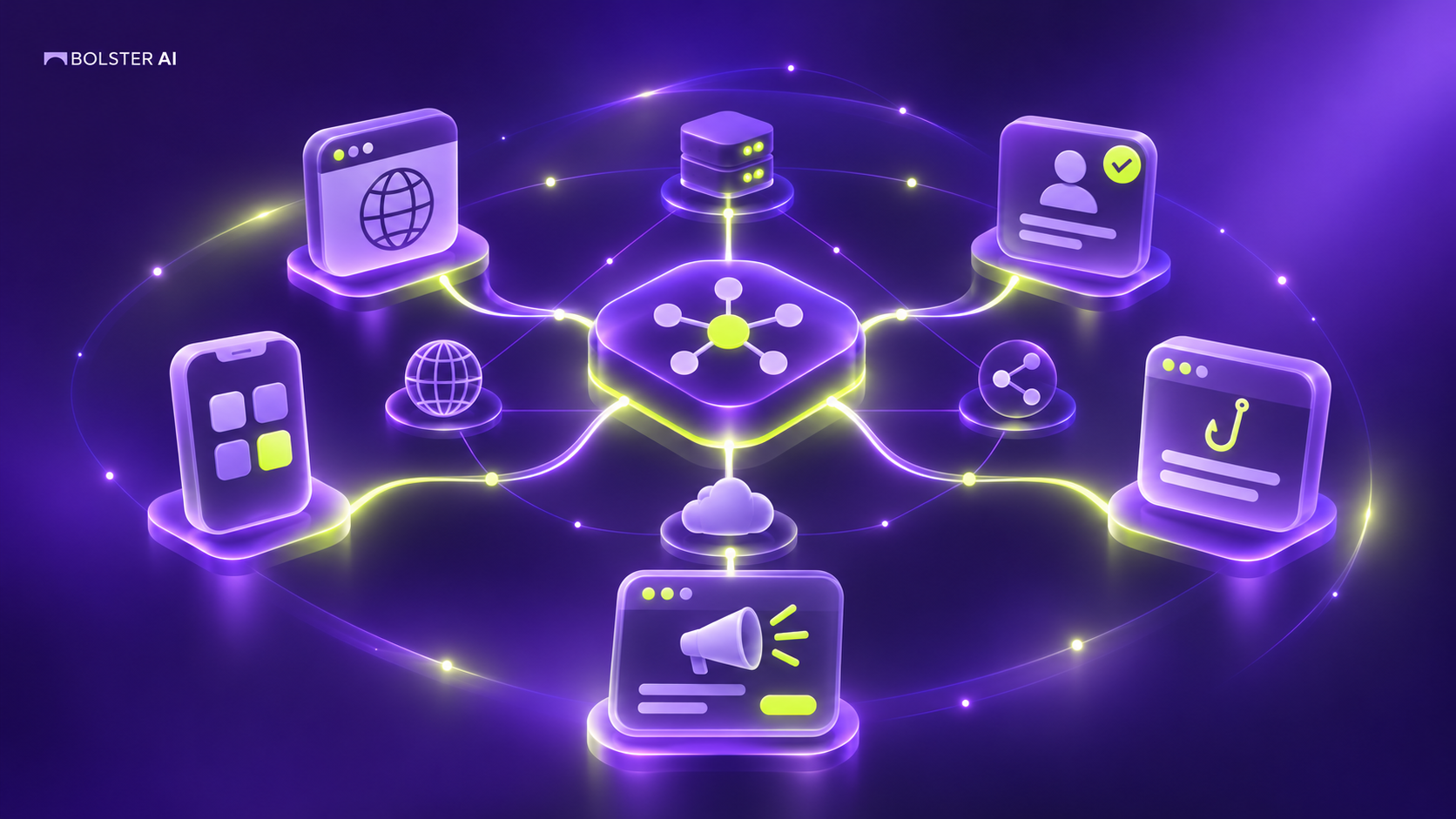
Fraudulent apps show up in app stores, built to look like the legitimate product and positioned to capture credentials or payment details once installed. Counterfeit listings turn up on marketplaces, trading on brand recognition to sell goods the company never made. Dark web credential markets are the least visible channel of all. Leaked logins and session data get traded there well before anyone connects the leak to a specific phishing campaign or compromised account.
Taken individually, each of these is a known, well-understood threat type with its own detection approach. Taken together, across the open web, social platforms, app stores, marketplaces, and the dark web, they represent the actual size of the attack surface a brand has to watch, and none of it appears automatically connected on arrival.
How separate detections get tied into one campaign
Turning separate detections into one campaign view is a matter of mapping relationships between the assets themselves, not just cataloging more of them. Group-IB describes this directly: maps how phishing sites, fake accounts, and fraudulent listings relate to one another, turning single detections into visibility into entire campaigns, using graph analysis and scam intelligence as the mechanism.
A graph in this context is a way of representing assets and the relationships between them, rather than a list. Instead of a flat table of findings, the system holds a web of connections: this domain shares a hosting provider with that one, this fake profile links out to that phishing page, this app listing uses the same branding template as a listing already flagged on a different marketplace. Each connection on its own might be weak evidence. Several connections pointing the same direction, across different assets, is a much stronger signal.
This is also where the client's broader workflow sequence actually earns its name: detect, investigate, connect, and act. Detection produces the individual finding. Investigation establishes what that finding actually is and who is likely behind it. Connection is the step that places it next to other findings sharing the same infrastructure or behavior. Only after that does enforcement decide what to take down and in what order.
Signals that indicate shared campaign infrastructure
The signals that support linking two detections are mostly infrastructure signals, not content similarity. Shared hosting between a newly registered lookalike domain and a domain already flagged in a prior campaign is a strong indicator the same actor is behind both. Matching registrant patterns across several lookalike domains, registered close together in time or through the same registrar, point the same direction.
Reused infrastructure shows up in other forms too: the same image assets repurposed across a fake social profile and a phishing site, the same payment processor embedded in a fraudulent app and a counterfeit listing, the same credential-harvesting template deployed on domains that otherwise look unrelated. None of these signals alone proves a connection. Together, they are the evidence an analyst or an automated system uses to decide that separate detections belong on the same campaign record rather than sitting in separate queues.
Evaluating correlation quality in a brand protection platform
If you're comparing platforms on this capability, channel count is the wrong starting point. A vendor that watches ten surfaces but never links a detection on one surface to a detection on another is not meaningfully different from running ten separate point tools. The question to ask is how detections get tied together, and how that linkage is validated before it's presented as fact.
Ask a vendor to walk through a specific example: a phishing domain, a fake account, and a leaked credential set, and how the platform would determine whether those three belong to the same actor. A vendor with real correlation depth can explain the signals involved, shared hosting, registrant patterns, reused content, behavioral overlap, and can explain what happens when the signals are ambiguous. A vendor without that depth will usually describe coverage instead, how many domains or platforms it watches, because coverage is easier to quantify and easier to market.
The distinction is not cosmetic. A security or fraud team acting on a false campaign wastes enforcement effort and legal review on assets that were never actually related. A team that misses a real campaign because the platform never connected the dots leaves exposure open longer than it needed to.
Takedown speed versus correlation depth
Takedown speed and correlation depth measure two different things, and it's worth keeping them separate when evaluating a platform. Takedown speed tells you how quickly a single confirmed threat gets removed once a decision has been made to act on it. It says nothing about whether that threat was correctly identified as one piece of a larger campaign before the takedown request went out.
A fast takedown on a misidentified or isolated threat can feel like progress while leaving the actual campaign untouched. If three domains, a fake profile, and a set of credentials are all run by the same operator, removing one domain quickly does not stop the other four assets from continuing to work, and the operator can simply stand up a replacement domain using the same infrastructure that was never flagged as related in the first place.
Correlation depth is what determines whether a takedown request addresses the actual scope of the problem. Speed matters once scope is understood. It matters less, and can even be misleading, when scope was never established.
Validating that a cluster is one actor, not coincidence
Correlation introduces its own version of the noise problem Group-IB describes with raw detection volume. A system that links assets too aggressively will cluster unrelated activity together under the assumption that it's one actor, which produces false campaigns and wastes enforcement effort on assets that have nothing to do with each other. A system that links too conservatively will miss a real, active campaign spread across multiple channels, leaving parts of it unaddressed.
This is exactly the same tension Group-IB identifies between missing real threats and drowning in false positives, applied one level up, to the correlation layer itself rather than the initial detection layer. Two domains sharing a hosting provider is a signal, not proof. Two lookalike domains with similar registration timing could be the same actor running a campaign, or they could be two unrelated registrants who happened to use the same low-cost registrar.
Bolster analysts stay in the loop for exactly this reason. Automated graph analysis does the work of surfacing candidate connections at a scale no human team could review manually, but edge cases, ambiguous signals, and borderline clusters still benefit from a trained analyst confirming that a proposed campaign is actually one actor's work before enforcement treats it that way.
Acting on a connected campaign
Once detections are confirmed as one campaign, the response changes shape. Instead of filing separate takedown requests against a domain, a profile, and a listing on three different timelines, the team acts on the full set of linked assets at once, which closes the campaign rather than trimming one piece off it.
Timing matters here because the window to act is short. Research on real-time brand monitoring notes that phishing domains often disappear within 24 hours, taken down by the attacker before enforcement catches up, only to reappear on new infrastructure. Continuous monitoring is what keeps that reappearance visible and tied back to the same campaign record rather than treated as a brand-new, unrelated detection each time.
Enforcement itself combines automated takedown workflows for the straightforward cases with analyst-reviewed escalation for anything that needs judgment, such as a registrar or host that pushes back, or a cluster where the link between assets needs a second look before action is taken. If your team is dealing with phishing sites, impersonation accounts, or dark web exposure that keep showing up as separate, unrelated tickets, it's worth seeing how campaign-level correlation changes that picture. Request a demo to see how Bolster connects detections into one view before deciding what to take down.
References
"Digital Brand Protection in Cybersecurity: Why It Matters in 2026 | Group-IB Blog." group-ib.com, https://www.group-ib.com/blog/digital-brand-protection-2026/.
"Best Brand Protection & Impersonation Monitoring Platforms in 2026 | Bitsight." bitsight.com, https://www.bitsight.com/guides/best-brand-protection-impersonation-monitoring-platforms.
"Using Real-Time Intelligence for Brand Protection." recordedfuture.com, https://www.recordedfuture.com/blog/real-time-intelligence-brand-protection.