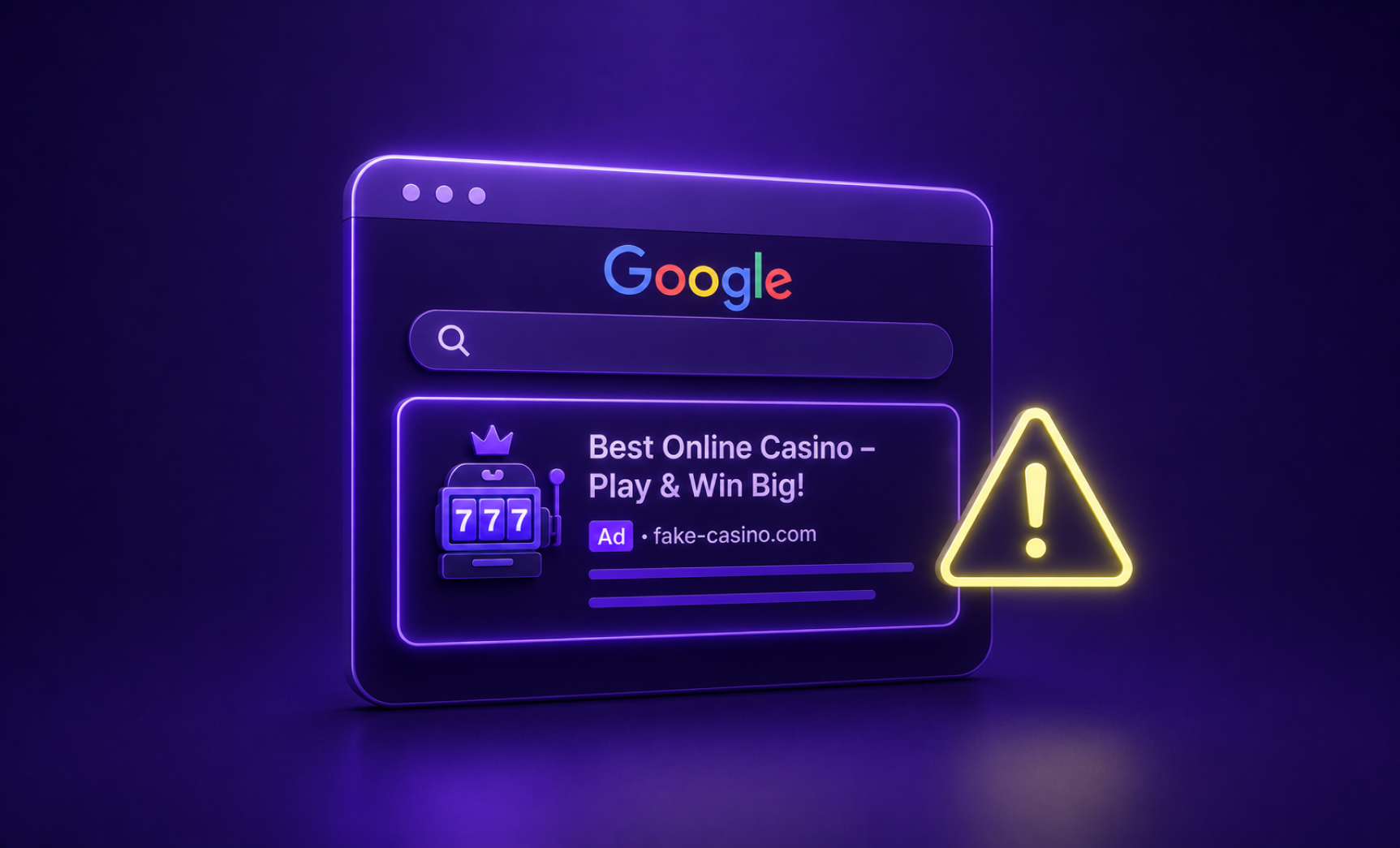
For a lot of operators, the honest answer is yes, they just haven’t found it yet. The player who searches your brand on their phone, clicks the top result, and deposits isn’t always depositing with you.
From our experience securing leading iGaming brands at Bolster AI, we can say this with confidence: SEO poisoning is no longer a fringe nuisance run by low-level affiliate marketers spamming keywords. It has evolved into a highly coordinated, multi-stage cybercrime enterprise designed to hijack the digital reputation of the world’s most trusted domains, and iGaming operators are among its favorite targets.
The damage lands twice. Players lose deposits to brand impersonation and blame you for it, and the search traffic you paid to earn gets quietly diverted to rivals. Here’s what the threat actually is, how it works, and what you can do about it.
What Is SEO Poisoning?
SEO poisoning is the manipulation of search engine ranking systems to push malicious or fraudulent pages up in results, usually by compromising legitimate websites and injecting content, links, or redirect logic that search crawlers trust. Unlike a defacement, nothing looks wrong. The compromised site appears completely normal to its owner and to casual visitors; the manipulation lives in the source code, where only crawlers read it.
The premise it exploits is simple: people trust the results page. For an iGaming operator, that trust is the entire business. The product isn’t your homepage; it’s your search result. Players find casinos and sportsbooks through Google, usually on mobile, and when a manipulated result ranks at or above the real site, the deposit goes to whoever holds that position.
What It Looks Like for iGaming Operators
In practice, operators face a handful of recurring patterns:
- Phishing clones. The poisoned result leads to a site impersonating the brand, harvesting logins and deposits without ever running a real casino. This is the highest-priority threat, because the player loses money and blames the operator.
- Traffic theft. Other clones quietly redirect players to a rival casino, converting the operator’s own search traffic into someone else’s affiliate payout. Lower stakes than credential theft, but real revenue walking out the door.
- Cloaked results. The fraudulent page shows a harmless decoy, a dentist’s office or a hospital, to anyone who checks it directly, and serves the phishing site only to mobile users arriving from search in the targeted country. Generic scanners see a clean page and move on.
- Typosquat churn. Scammers register near-miss variants of operator domains, one character off, and replace them the same day they’re taken down. For operators in high-abuse markets, this can mean well over a hundred takedowns a month.
Here’s exactly how modern threat actors pull it off, phase by phase.
Phase 1: The Initial Compromise
Modern attackers don’t brute-force passwords; they hunt for systemic vulnerabilities. Unit 42’s incident response research has tracked vulnerability exploitation as one of the most common ways attackers gain initial access, and CMS platforms are a favorite target because a single flaw unlocks thousands of sites at once.
A prime example is the exploitation of CVE-2026-26980, a flaw in the widely used Ghost CMS that let attackers pull sensitive data straight from the database, eventually including the admin keys to the platform itself. With those keys in hand, attackers programmatically altered existing articles to inject malicious payloads at massive scale.
The fallout was staggering: over 700 websites globally were compromised, including major brands like DuckDuckGo and prestigious academic institutions like Harvard and Oxford.
Phase 2: Malicious Injection and the At of the Cloak
Once access is secured, the second phase begins: malicious content injection. The goal is to poison search results by embedding malicious scripts or code into the compromised website’s files.
In the Ghost CMS attack, the stolen keys were used to slip malicious script loaders into existing articles. The injected code is usually designed to stay invisible, activating only under specific conditions (a particular device, a certain time of day) so that routine audits and manual reviews come back clean. Other campaigns, like the long-running DollyWay operation, injected code at the server level instead, giving attackers even deeper control over what the site serves, and to whom.
The real sophistication shows up in cloaking. The compromised server fingerprints every requester and serves each one a different reality:
| Requester type | Signal detected | What the server delivers |
| Search engine crawler | User-Agent: Googlebot or Bingbot | High-density, hyper-optimized HTML pages stuffed with thousands of gaming keywords (“rummy,” “slots,” “no-deposit bonus”) |
| Security sandbox | No referral header, clean IP | A generic 404 Not Found page, or a completely benign page, to escape automated discovery |
| Organic human visitor | Referer: google.com or bing.com | An instantaneous 302 redirect routing the user away from the trusted site and into an underground gambling network |
Cloaking has also gone geographic. Some campaigns serve a benign decoy page to anyone visiting directly or from a desktop, and reveal the phishing site only to mobile users arriving from search results in the targeted country. Detection tooling that scans from a data center IP in the wrong geography sees a clean site every time.
SEO Poisoning as a Service: The Link-Injection Market
Not every compromised site hosts the scam itself. A thriving underground market sells injected links on hacked, high-authority websites, and buyers simply choose the keywords and the URLs they want boosted. The injected code pairs each link with anchor text tuned to high-value search terms, with gambling phrases among the most common targets, and because the links sit on domains search engines already trust (.gov, .edu, and country-code TLDs carry particular weight), the fraudulent site inherits that authority artificially.
Visitors see nothing. Crawlers see an endorsement. The result is that attacker-controlled pages can rank alongside, or above, the legitimate brand for its own keywords, without the attacker ever touching the brand’s infrastructure. And because the manipulation happens on websites the operator doesn’t own or control, the native remedy is slow and indirect: compromised site owners have to notice the abuse and disavow the links through Google Search Console, assuming they ever find out at all.
Phase 3: Delivering the Payload
The third phase, redirection and traffic manipulation, is where the deception becomes most visible to the end user. Modern SEO poisoning campaigns use sophisticated architectures to make sure victims are effectively hijacked from the legitimate site to the malicious one.
One of the most deceptive techniques, featured prominently in the DollyWay campaign, is the full-screen overlay: injected code draws a new layer over the entire browser window and loads the fraudulent gambling page inside it, so it looks like the player simply landed on a new site. The legitimate page is still there underneath, invisible, and closing the overlay can be difficult or impossible. To the player, nothing ever looked wrong.
The payloads themselves are built to dodge inspection. In one recent campaign documented by Microsoft, malware delivered through poisoned search results checked for telltale signs of a security sandbox before running, executing only on real victim machines. The practical takeaway for operators: the tooling that’s supposed to catch these threats is exactly what they’re engineered to fool.
The basic flow: compromise → inject → cloak → redirect → monetize.
The 2026 Trajectory: AI and Total Convergence
The days of basic black-hat tactics, like the decade-long DollyWay campaign that compromised over 20,000 WordPress sites using simple PHP injections, are fading.
As we move through 2026, artificial intelligence has become a massive force multiplier. Attackers are leveraging AI to automate vulnerability discovery, scanning millions of lines of open-source CMS code to identify zero-day flaws before they can be patched. The defensive side is racing to keep up, and the evolution of AI fraud detection in iGaming shows just how quickly both sides of this arms race are moving. Bolster AI’s detection models are purpose-built to catch these patterns at scale and protect the customer trust these campaigns are designed to exploit.
We’re also witnessing the convergence of monetization models: a single compromised session can now serve a full-screen overlay for a fraudulent iGaming offer and redirect to an AI-generated phishing page for credential theft in the same breath.
And the infrastructure behind these campaigns is decentralizing. The DollyWay operation recently shifted from a dedicated traffic broker network to pulling redirect URLs from a public Telegram channel, trading a central point of failure for something far harder to disrupt. For operators, the implication is blunt: the window between a clone appearing and a player depositing into it keeps shrinking, and response speed matters more every year.
None of this is theoretical. In the past year, researchers at Elastic tracked a single group that compromised over 1,800 Windows web servers to funnel everyday search users into illegal gambling networks and crypto phishing portals, and more than 100 Indian government websites were caught silently routing mobile search traffic to illicit betting apps, prompting a national advisory from the Indian Cyber Crime Coordination Centre on black-hat SEO networks. Gambling isn’t one target among many for these campaigns. It’s the center of gravity.
What Operators Can Actually Do
The instinct is to treat this as a security problem for the compromised websites, and for them it is: rigorous patching of CMS platforms, themes, and plugins is what starves these campaigns of raw material. But if you’re the operator being impersonated, your infrastructure was never touched. You can’t patch your way out of someone else’s hacked website. Effective digital brand protection for operators comes down to four things:
- Visibility into your own search results. You can’t prioritize what you can’t see. Continuous monitoring for lookalike domains and clones, mapped against which ones actually rank for your highest-value keywords, separates the fakes stealing deposits from the ones sitting harmlessly on page nine.
- Detection built for cloaking. Scanning has to browse the way real players do: from the right country, on mobile, arriving from search results. Anything less and the decoy page passes every check while the phishing site keeps collecting deposits.
- Speed and follow-through on removal. Every hour a clone holds a ranking costs deposits, so the response has to work on two clocks at once: getting warnings in front of players quickly while takedowns work through hosting providers and registrars, then watching for the same-day replacements so removal doesn’t become whack-a-mole.
- Enforcement that knows what’s yours. Operators run legitimate mirrors, affiliate sites, and rotating domains that can look suspicious from the outside. Takedown workflows need a whitelist and an approval step, so protecting your brand never means knocking out your own infrastructure.
One honest caveat: no vendor can promise you rankings or remove results from Google’s index. Only Google controls the index, and only a site’s owner can disavow manipulated links pointing at it. What can be controlled is how fast the infringing sites outranking you are found, and how fast they come down.
SEO poisoning isn’t just a marketing problem. It’s a direct attack on your revenue and your players’ trust. Stop the clones, and you stop the bleeding.
Request a demo to see which clones are targeting your brand and how Bolster AI takes them down.